
A good practice is really important - Consultecca

Management in a healthcare institution
Health care institution is very active and complex. All activities and business goals can be focused on the patients /clients, and/or at the same time to the business results or capacity.
Making the decision to go in the process of changes is always very brave, it needs a mastering a lot of challenges and barriers. In this process have to use a leadership approach. Authors Srića and Kaufman suggest using catalysator management, which can influence the team members, support each team member and through the coaching process help each to utilize the maximum of own value. Using catalysator management each leader by the own example leads to the best practice. Catalysator management is the most damaging kind of leading and including cognitive, technical and interpersonal skills and knowledge. (Srića & Kaufman, 2019)
Management needs and perspective in healthcare
Elementary needments healthcare institution is to achieving goals and results in financial efficacy and goals for quality control. For realization efficacy, it needs to achieve effectiveness. Wisdom and strategy planning are the only correct way and perspective process management processes in medicine. (Svetic Cisic, 2019)
Definition and finding aims for achievement efficacy and efficient results
The orientation of the efficacy is on the time and process of conduction, measure and definition time which is planned for activities. To do activities in a very short time has to try, with minimum budget, persons and equipment.
Efficacy has to focus on achievement planned aims, without measuring efficacy, only focused on time and money. (Goleš, 2018)
Internal and external activities
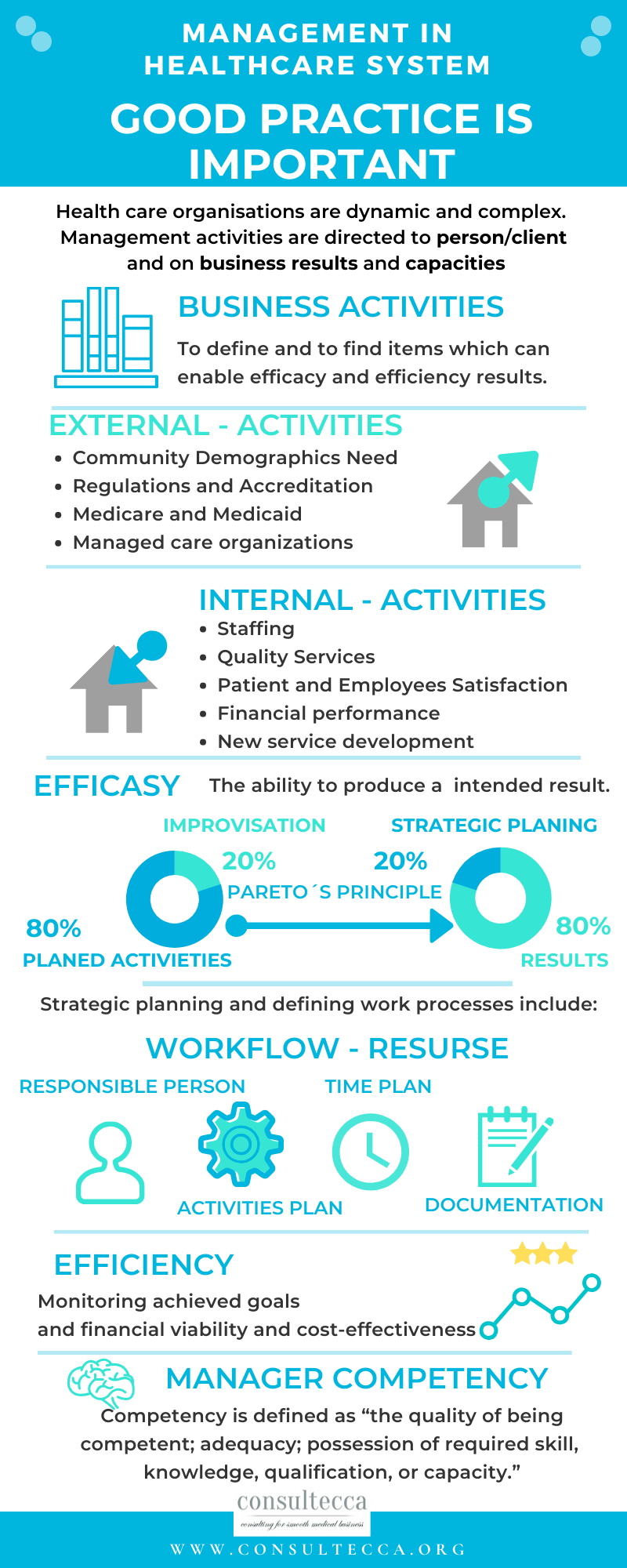
Managements activities in health care system is differentiated regarding to intern and extern shape. (Holder, 2019)
Internal activities
- Planning and definition aims with very clear efficient and efficacy results
- Coaching each team member in professional development, yearly peer review performance, measure index fluctuation, strategy plan to achievement aims and tactics to hiring the best professionals (Svetic Cisic R., 2016)
- In the modern health care institution, the organizing principle is a matrix, less pyramid hierarchy
- Implementation quality assurance with definition aims qualities through medicine’s relevant aims
- Leadership approach, with using motivation, development, emotional intelligence and excellent communication skills
- Making effective and efficient decisions (Goldsmith, 2012)
-
External activities
- Supporting and focusing on demographic needs
- Following legislative and guidelines
- Implementing accreditation’s activities
- Collaborating with insurance companies
- Representing the institution in the best way and lobbing (Goldsmith, 2012)
Management position in healthcare institution
High management commitment and leadership skills in a healthcare organization are important. Sharing the same values through high, middle and low-level management.
All managers from each level are important and have an own rule in all processes od decision making, achievement business aims and implementation of quality assurance and using resources. Sharing information and open two ways communication is the basis for final success, efficacy, and prosperity.
Efficacy in a healthcare institution
Basic activity is to define the business process and to definition intervention, responsible person, documentation, medical equipment and time. (Infographic1) Using Paretto’s law and definition 80% of intervention can be helpful for harmony and efficacy through the business process. The rule is that only 20% of activities can be improvised and can be adapt according to the current situation. (Infographic1) Investing 20% of your time in strategic planning will yield 80% of results and lead to success. In such an organized system, employee satisfaction and thus customer satisfaction are achieved.
Successful set goals
Establishing quality management requires defining goals, monitoring, and an annual report. It is necessary to define and implement goals in the field of medicine and monitor their success. Each field of medicine has specific indicators that should be defined at the level of senior and middle management, with the support of high management.
In nursing, one of the disciplines of management in the healthcare system, some of the quality indicators such as are:
- Monitoring high risk for fall and correlation with fall incidents
- Monitoring of decubitus occurring at the institution or occurring during previous hospitalizations
- Continuous education and active or passive participation
- Hand hygiene and monitoring 200 moments hand hygiene according to WHO recommendation (WHO, 2009)
- Monitoring patient’s/client’s satisfaction with nurses, physicians or other multidisciplinary team members
- Monitoring patient’s pain and definition of acceptable postoperative physiology pain
Planning strategy
Competitive atmosphere in healthcare service requires a high level of motivation, development of management skills, continue education and continue extensive knowledge. This is basic for managers in low, middle or high management. Developed leadership skills, along with catalytic management implementation processes, a positive example of own practice can influence associates, team members and encourage them to be engaged, proactive, create a positive atmosphere of acceptance and support. Only in such conditions is growth and development possible. A carefully crafted strategy carefully planned with the use of SWOT analysis is a roadmap to be pursued in order to achieve efficiency and effectiveness. (Svetic Cisic, 2019)
Managers competences
Each successfully leading and implementation management principle is depending on the management/leadership skills of the director. Competences are defined by Lotich and are including skills, knowledge, qualification, and abilities to lead. (Lotich, 2015)
Twelve keys leadership competences
- Supervision – professional feedback and supervision employees, using management instruments (for example peer review –
- Conflict resolution – establishing an organizational supporting culture which doesn’t tolerate any kind of violence or conflict
- Emotional intelligence- understanding and control emotion, other and own emotions, implementation ei and influence ei on the final success
- Communication skills in verbal and written communication. They require a structured communication process and defined modes of communication. Thinking about activities and channels of communication with employees, team members, and answering questions: when, how often, and by what means to communicate.
- Effective management – clear and open expectations from employees, job description, feedback about work efficacy, mentoring and supporting and public praise.
- Interviewing skills with prospective new hires – introducing yourself to a CV, structured questions, and conducting a documented assessment during the interview.
- Team building – using basic skills to work in a team.
- Delegation – the ability to delegate jobs and show confidence in team members.
- Consulting services – the use of the services of professionals from other industries for growth and advancement and for the achievement of strategic goals.
- Coaching – Assisting associates to develop and utilize their best potential and thus achieve their own professional goals and contribute to the institution in achieving its goals.
- Problem Solving – Challenges and problems are part of everyday life and the ability to find optimal successful ways to overcome and effective solutions.
- Motivation – Every leader should know how to motivate and inspire employees and become aware of the needs of these activities. As there is no unique formula for all, it is successful and worthwhile to apply the motivation and inspiration applied to each individual. (Lotich, 2015)
Conclusion:
The complexity of health care organization, there dynamic, complex workflow process and financial specific requirement demand from management personal knowledge, skills, leadership. Work process with clear definition activities, responsible persons and documentation enable efficacy, monitoring work process in the time, achievement financial aims and quality control goals. Wisdom strategy, monitoring efficacy and efficiency leading to successful management in the healthcare system.
Keywords
Efficacy, efficiency, competence, management, leadership, strategyA good practice is really important
Literatura
Goleš, D. (03. 02 2018). bizpro.hr/efikasnost-i-ili-ucinkovitost-isto/. Dohvaćeno iz https://www.bizpro.hr: https://www.bizpro.hr/efikasnost-i-ili-ucinkovitost-isto/
Holder, H. (05 2019). Jones and Bartlett Publishers, LLC. Dohvaćeno iz Managing the hospital and social care interface – The Nuffield Trust: https://samples.jbpub.com/9780763759643/59643_CH02_5289.pdf
Srića, V., & Kaufman, I. (12. 04 2019). The World is Broken We Need to Fix It. Dohvaćeno iz https://skopemag.com: https://skopemag.com/2019/04/12/ira-kaufman-velimir-srica-presents-the-world-is-broken-we-need-to-fix-it-path-to-strategic-harmony
Svetic Cisic, R. (03. 04 2019). Mudra strategija za uvođenje promjena u zdravstvenim ustanovama – Consultecca. Dohvaćeno iz Consultecca.org: https://www.consultecca.org/mudra-strategija-za-uvodenje-promjena-u-zdravstvenim-ustanovama/
Lotich, P. (01. 07 2015). thethrivingsmallbusiness.com/manager-competencies/. Dohvaćeno iz thethrivingsmallbusiness.com: https://thethrivingsmallbusiness.com/manager-competencies/
Svetic Cisic R., F. S. (2016). Using Nursing Peer Review for Quality Improvement and Professional Development with Focus on Standards of Professional Performance. Nursing and Health, Vol. 3(5), pp. 103 – 109.
WHO. (2009). Save lives, Clean your hands. Dohvaćeno iz World Health Organization : https://apps.who.int/iris/bitstream/handle/10665/44196/9789241598606_eng.pdf?sequence=1
Goldsmith, S. B. (2012). Understanding Healthcare management. U S. B. Goldsmith, Understanding Health Care Management: A Case Study Approach 1st Edition (str. 17-31). Massachusetts: Jones & Bartlett Learning;

